Amnesia, Inscriptions
Harvard GSD, Spring 2026
Independent Project
Advisor: K. Michael Hays
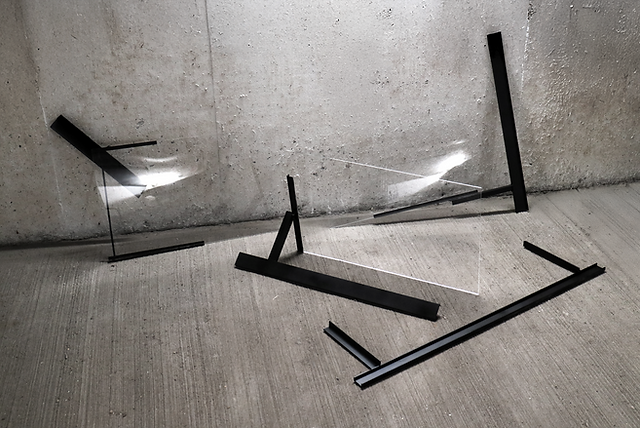
Materials: aluminum (TIG-welded), plexiglass, marking tape, strobe light.
Marking systems inscribe order through repetition, scripting the unconscious. Engaging trace—inscriptions registering excess beyond structure—temporally, this series of installations introduces cuts into this repetition through a system of marks that reconfigure time, movement, and perception within a flight of stairs.
Identifying ontic distinctions (Siegert) within the staircase, the project disrupts their stabilization, opening a rupture in symbolic structuring. It installs a sequence of operations—registration, misregistration, transposition, and transference—that displace the distinctions of threshold from a tectonic frame on the door into a progressively disorienting perceptual condition.
Treating glass as an indexical medium (Krauss), the threshold is transferred into glass as a trace rather than a sign. Displaced in reflection and discretized by strobe light, the trace decouples vertical orientation from bodily movement, interrupts linear perceptual continuity, and amplifies rotational misalignment at the landing. The sequence folds back to its beginning, now re-encountered.
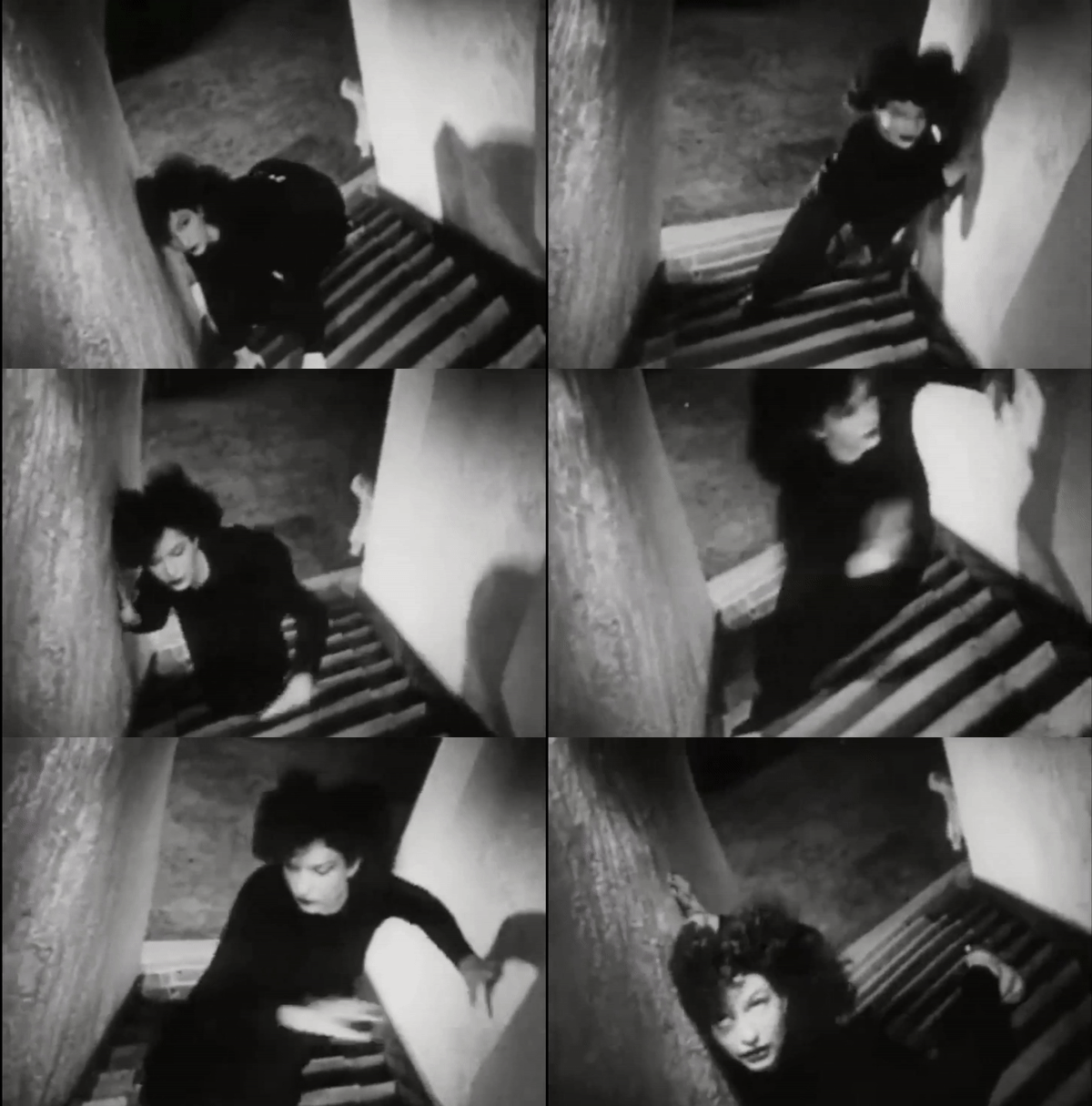
Maya Deren, Meshes of The Afternoon


Strobe light: 1 hz

Strobe light: 6 hz

References
Derrida, Jacques. “Structure, Sign, and Play in the Discourse of the Human Sciences.” In Writing and Difference, 1978.
Stan Allen, “Plotting Traces: On Process,” in Practice: Architecture, Technique and Representation, 2000.
Elizabeth Stewart, “Benjamin and Lacan” in Catastrophe and Survival: Walter Benjamin and Psychoanalysis, 2012.
Rosalind Krauss, “Notes on the Index: Seventies Art in America,” in October, 1977.
Siegert, Bernhard. “Doors: On the Materiality of the Symbolic.” in Grey Room, 2012.
Siegert, Bernhard. “After the Media: The Textility of Cultural Techniques.” In Media Theory and Cultural Technologies: In Memoriam, Friedrich Kittler, 2017.