Afterimage Inscriptions
Glass Memories
Harvard GSD, Fall 2025, Elective
Independent Project
Instructor: Craig Douglas
Glass produces perceptual instabilities: transparency, reflection, and refraction collapse dimensional references into surface, complicating the relation between appearance and spatial reality. This project examines how such instability, in which spatial reference is no longer reliable, conditions perception.
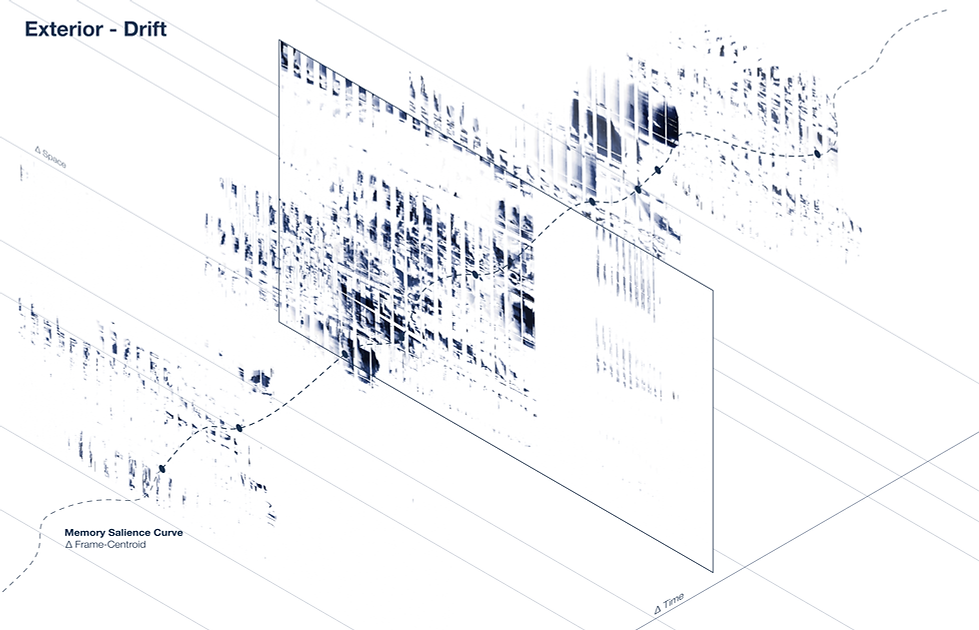
Under this condition, perception is rendered to organize through patterns of change over time. Counterposing spatial extensivity against the intensities of temporal events, a designed imaging system extracts fleeting motions into residual traces that fade, overlap, and persist. Where forces of disappearance and persistence counteract, each new motion actualizes in relation to the afterimages of the past.
As the film captures appearance in its emergence and flux, the drawings formalize its persistence through a system that maps memory across time and space. The system traces pre-attentive salience through frame centroids, and articulates loci where recurring motion condenses into temporal densities. Linking global shifts in perceptual weight with localized intensification of retention, the drawings show how mnemonic duration distorts the registration of temporal and spatial realities.
The surface begins to "dream" in multiplicities, as shifting traces form a spatial palimpsest through which time and memory unsettle the certainty of appearance.
Methods:
Custom HTML-based imaging interface
Python-driven sampling in Rhino


References
DeLanda, Manuel. “Space: Extensive and Intensive, Actual and Virtual.” 2005.
Deleuze, Gilles. Difference and Repetition. 1994.
Tschumi, Bernard. Architecture and Disjunction. 1994.